Unknown's avatar

About The Tuesday Prude

I always told my husband I fell in love with him before I know his last name. Good thing, too. I'm beginning to enjoy my unusual and sturdy married name. Klumpers are almost as rare as prudes. However, in an effort to make it a more common household name I bore 3 sons, all Klumpers, and a recent Klumpers grandson has been added to the lists. In an effort to make prudishness a more common household virtue, I have created this blog.

Writing without widgets

falling_rocks
I am a rock. I am an island.
(Simon and Garfunkel ‘I am a Rock’)

That is me. An rock of oblivion and an island of inflexibility
standing firm in the raging torrent of social media.
Here’s the thing about rocks and islands.
We don’t stand firm because we are strong
and steadfast and resolute.
We are stuck.
Have you ever seen an island pull up stakes to follow the crowd?
And rocks. Not known for trendiness.

Several years ago I thought it would be fun to start writing a book.
Once I got some impetus going I thought it would be fun to finish it.
What could be more fun than finishing a book?
Submitting it to a publisher!
Oh! Oh!
And then getting it published!
Having family and friends buy it!
This rolling stone was gathering no moss.

Until, in a parallel universe—the actual one—I came to realize that the rolling, moss-shedding author
was a temporary illusion.
The real me is the unmoving rocky island with roots to the center of the earth.
An atoll (there are very few synonyms for ‘island’) who is learning that writers eventually  run out of family and friends to purchase one’s book. The glorious ‘I am a published author’ ride
hits the rocks.
And one needs to
PROMOTE.

Promotion is double horror for a rock and an island:
One needs to be confident and outgoing. Creative and fearless. Rocks are not known for these qualities. We prefer to blend into the scenery and have people sit on us.

And one needs to have moved from newspaper interviews/genteel bookstore readings and into Twitter feeds and author pages and likes on Facebook and blog widgets and avatars and all the things islands just can’t cope with.

But the world of social media and self-promotion is lapping at my rocky shores.
I’ve cajoled and convinced everyone I know to buy my book and I can’t make new friends or relatives fast enough to generate glowing book sales.

So I’ll do what I can to appear that I am busily promoting, without actually moving.

*************
I wrote a book folks! A suspense/romance mystery!
It’s called ‘Winter Watch’ and my real name (really) is Anita Klumpers
Publisher: Prism Book Group
Available in paperback and ebook from Amazon, Barnes and Noble, Smashwords
and various other online sites.
*************
There.
That didn’t hurt a bit.
But my editor is heading this way with a few sticks of TNT.
My island days are numbered.
Look for bits and pieces of my rocky self bobbing along in the social media world,
gasping out tweets and hanging onto a widget for dear life.

Lily-Livered Literary Devices

Real life wreaks havoc with perfectly good literary devices.
In the hands of professionals, these devices make the world of literature a finer place.
When rank amateurs throw them around, the term ‘verbal abuse’ takes on a whole new meaning.

The simile, saying something is like something else, requires an imaginative mind and clarity of expression:
He uttered a sound much like a bull dog swallowing a pork chop whose dimensions it has underestimated. (PG Wodehouse)
Let an American teens get hold of it and the simile turns into:
‘I was like, just standing there and he, like, winked at me and I, like, died!’

When Edna St. Vincent Millay wrote, “I like humanity, but I loathe persons.” she was brilliantly employing an oxymoron.
When we speak of government intelligence or peacekeeping force or media integrity or red licorice we just use one word in the phrase to cancel out the other.

Anthropomorphism, attributing human characteristics to animals (sometimes interchangeable with personification) raises our consciousness with totalitarian critters in ‘Animal Farm’ or raises an entire generation of anti-hunting protestors with ‘Bambi.’
Now, commercials try to work up sympathy for lonely cleaning products pining for love in attics. Movies like ‘Toy Story’ and ‘Brave Little Toaster’ convince us that we can’t throw out broken plastic playthings or obsolete appliances because they have feelings too. That just raises my blood pressure.

Euphemisms. Ah. A way to take something prosaic, unpleasant or distressing and make it palatable.
Lucy wasn’t pregnant in ‘I Love Lucy.’ She was expecting. Sometimes women in the 1950’s were in the family way or on the nest or visited by the stork but they were NEVER pregnant.
‘The Godfather’ movies made threatening the life of another sound positively appealing by ‘making someone an offer they can’t refuse.’
See how clever these euphemisms are?
Compare them to the politician who has lied, cheated and stolen. Will he admit to lying, cheating etc? No. He will admit that ‘mistakes were made.’
Collateral damage, friendly fire and enhanced interrogation all have a pleasant ring to them.
Someone had the bright idea to call  taxes ‘revenue enhancements.’
See how clever those euphemisms are?

Portmanteau is that fun little device that joins 2 words to make a new word. Lewis Carroll combined ‘lithe’ and ‘slimy’ to make the great word slithy in Jabberwocky. Smog? I can handle that. Motel? Very clever. How can human beings who come up with a delight called brunch also have infomercials and Brangelina and TomKat?

Invective. If you have ever read the comment section on YouTube videos, blogs, opinion columns,  etc., you’ve probably run across invective. Invective is that nasty, spiteful, lewd, venom-dripping-from-each-word sort of response Internet trolls like to use. Like real trolls, these scourges of social media have a limited vocabulary and use the same 4 letter words over and over and over.
Compare invective in the hands of a master. Shakespeare’s King Lear addresses his faithless daughter’s servant as such: “A knave, a rascal, an eater of broken meats; a base, proud, shallow, beggarly, three-suited, hundred-pound, filthy worsted-stocking knave; a lily-livered, action-taking, whoreson, glass-gazing, super-serviceable, finical rogue; one-trunk-inheriting slave; one that wouldst be a bawd in way of good service, and art nothing but the composition of a knave, beggar, coward, pander, and the son and heir to a mongrel bitch: one whom I will beat into clamorous whining if thou deni’st the least syllable of thy addition.”(William Shakespeare “King Lear”, II.2)
Maybe when Internet trolls start using words like ‘ beggardly’ and ‘lily-livered’ and ‘filthy worsted-stocking knave’ we can take them more seriously.

GOING GRAY

SONY DSCPeople of a certain delicate age, we decided last time out, don’t really forget stuff. We just misplace it for a time.
This week we face another conundrum. Why do decisions that were once clear-cut now have more angles than a 10th grade geometry book? When did snap judgements expand to Supreme Court-deliberation length?
Why does a final, rock solid decision continuously elude me?

Something else is going on here. It isn’t only the sheer amount of stuff shoved into my memory bank.
It’s the filter.
My filter assigns virtue to incoming information.
Like my hair, the filter is getting gray and brittle.
Another scourge of middle age.

My grandsons are infants. The world is white to them. Everything, and I mean EVERYTHING, centers around their needs. A nuclear explosion could erupt in the next town and they would demand a diaper change. Naptime can’t wait for important phone calls to end and they really have no use for Mommy’s migraine when their little tummies rumble. The world is straightforward and monochrome. It is responsible for making them happy and keeping them safe. All is white.

By the time these little ones hit their teenage stride something remarkable will have happened.
Another color, another dimension, will have gradually crept into their ‘me’ world.
Black takes its place along white.
Now, while still wanting to fulfill their own pleasures and needs, these blossoming youth comprehend that some things are bad. They will begin assessing data and assigning colors.
Is this good or bad? Black or is it white?
Decision making over all that info takes more time. They no longer see just a white spotlight focussed on their own needs. They see the dark of wrong, bad, evil. Their brains have more information to process. Not only are they working with more experience to apply to the info. They have to make a judgement call.
Black or white?
Life isn’t entirely simple.
But it still is sort of simple. Rarely in the idealistic absolutes of youth do black and white puddle together into ambiguity.

Here at the tail end of middle age, black and white are no longer the primary colors used by my brain to file information, make an application and deduce, “This is bad. That is good. She is evil. He is pure. Do this. Don’t do that.”

Grayness has set in. So few of the decisions are easy. Implications abound. While some actions I observe are overtly evil or obviously good, I have learned (oh, blast that experience!) that quick verdicts are not always easy to make.
Judgment calls require the sifting of acquired wisdom and accumulated experience and hits and misses. We are so much slower than we used to be because our filter has so much more to sort. Lean chicken or marbled steak? Spankings or time outs? Liberal Republican or conservative Democrat? What does ‘in the world but not of it’ look like? Will the shabby man begging for spare change spend it on liquor? How can one tired finite mind figure this all out?

Humans and situations and issues are complex. People can do bad things with good intentions. Charitable actions can have self-serving motives, honorable nations can fight dishonorable wars and every story doesn’t have 2 sides. It might have a dozen.

There are absolutes in the world. I respect them but understand that fallible humans have trouble living those absolutes absolutely. I respect justice but crave mercy. The gray filter of my mind has seen the dark recesses of my heart struggle with the brightness of Good. It reminds me how foolhardy and hypocritical a rush to judgement can be.
At the same time my brittle, tired filter longs for the day when I won’t have to analyze, appraise and critique myself or others or issues or events.

Someday, my gray filter won’t be needed. All will be White. And I’ll have eternity to enjoy the chicken AND the steak.

The Muddle-Aged Brain Retrieval System

Government_Warehouse
Among my many non-accomplishes is typing. Sometimes I pretend I can type and gallop along the keyboard not looking at my fingers. And type ‘muddle-aged’ instead of ‘middle-aged.’
Serendipitously, muddle age is a perfect description of where I am in life. Drop in for a visit and chances are you’ll find me gripping my head in a frantic attempt to keep my brains inside. Or at least the stuff I have crammed into my brain inside.

I misplace the end of sentences before I get there. I misplace my children’s names.
I misplace stanzas of songs, secret hiding places and crucial ingredients in a recipe.They are all someplace in my brain. Under stacks and piles of important information, interesting trivia and complete rubbish is filed everything I need to function.

But here’s the thing: the muddle-aged brain’s retrieval system is on overload.

Years ago, my infant brain had very little to fetch and carry. Its memory file was virtually empty, and needed only respond to signals that I was hungry, sleepy, lonely, or had something mushy in my diaper. Infant Brain, upon reception of any such data, simply roused itself from a peaceful nap, reached over to the single file drawer with the single folder and pulled out the lone sheet inscribed with one word. CRY. And I did.

By the time I and my brain reached our teen years we had acquired an increasingly complex and sophisticated storage system.  Teen brain still used that CRY go-to folder, but had added file cabinets to store a dozen plus years of experience, acquaintances, analysis, and events. Of course, the file cabinets stood empty while the above data was flung willy-nilly in various brain corners, and covered in layers and layers of emotion.

So when Teen Brain needed to retrieve something, depending on its importance, it would kick at some piles and fling others into the air. The phone number of the cute guy on the bus was always remarkably accessible, while family rules regarding telephone usage were shoved in the dank cellar of my furthest brain cavity. The messy piles, however, were of manageable size simply because I was still young.

But now the I have reached the age of muddling. It isn’t that the bad habits Teen Brain and I developed re-surfaced. I truly have sorted and filed my events, experiences, data and trivia and etc. But several decades of material is stacked in a brain that not only isn’t very large, but has other important jobs to perform.

Here’s what the memory storage part of my brain looks like:
The warehouse at the very end of ‘Raiders of the Lost Ark.’
Remember? Where the ark is crated and unloaded in an enormous storage building amongst hundreds of thousands of other crates, containing who knows what?
Some Brain Crates contain the most precious of memories, like my father playing harmonica to my babies, and important stuff, like my social security number and my husband’s eye color.  Others are packed with junk that I just can’t seem to get rid of, like the lyrics to ‘Dead Skunk in the Middle of the Road’ and the memory of my grandpa’s Pomeranian eating his toenail clippings.
But they are all crammed and stacked and marked with smudged or confusing labels.
Is it any wonder that my brain and I either misplace a plethora of essentials or locate them at the wrong time?

When that happens, my brain reverts to default infanthood setting, dashes for that single sheet of paper and its lone word and comes back waving it triumphantly.
CRY? And I do.

Somalia is the new Bangladesh

As children grow and develop their humor sense, they learn the delights of shared ridicule. If we’ve raised our children right they won’t ridicule peers or authority figures or those different from them. They’ll mock us.

A gaggle of post-littles/pre-teens guffaw as they cross eyes and loll out tongues.
“Your mom says your face will stay that way? Mine does too!”
Or, “Does your mom ever say, “If your friends were all jumping off a cliff would you?”
And then one will chime in,
“My folks always say, ‘wait till you have kids of your own.’”
At this point they all laugh uproariously. Kids of their own?
That day is, like, a million years in the future.

And then comes the inevitable: “My mom always says, ‘Eat your vegetables! There are starving children in Somalia!’ So I say, ‘If they want my Lima beans so bad they can have them!’”

Some moms might sub in India or the Sudan or North Korea.
But the Momism is the same. When I was growing up the children in Bangladesh were starving.
I wondered how eating my liver and Brussels Sprouts would fill their stomachs.

It wouldn’t. So why don’t moms can this ridiculous phrase? Its been around longer than I have.
As long as America has had so much food that almost half of it goes to waste.
As long as children see buffet lines with more options than their phones have apps.
As long as first world children have never known the gnawing ache of hunger.
Not temporary hunger pangs, but the
agonizing starvation that distends little tummies while shrinking little bodies to loosely fleshed skeletons.

As long as our children can pile food on their plates and after a few bites toss the rest, words about starving children have little impact.

Moms have a lot to deal with. Children have food preferences and sensitivities. Many moms need to keep kids safe from allergens and pesticides. We don’t want our kids falling into eating disorders so we don’t tell them to clean their plates.

We have so much food that sometimes we view it as an enemy instead of realizing how precious it is.
We need to learn ourselves and teach our children that full tables and refrigerators and pantries aren’t our right, but a blessing and privilege.

Let’s exercise our imaginations. Picture one of those little ones from India or Somalia or somewhere in our own city who doesn’t have enough to eat. Imagine them watching us scrape good food into the trash. Imagine a child—who washed dung from seeds for something to eat—sees us turn up fussy noses at meat, potatoes and 2 kinds of vegetables.
Or liver and Brussels Sprouts.

I, too, need pictures of those empty babies with the puzzled eyes
next time I am too lazy to heat up leftovers and order out for pizza. Or when I wait till the food in the fridge turns green and I can just dump it.

“You have so much,” the hollow voices say. “Please, respect it. We do.”

Another Momism: We don’t know what we have till its gone.

An attitude of humble gratefulness and stewardship can grow and spill out. It creates empathy which creates people who not only enjoy the blessing of food, but share it.

Lord, this Thanksgiving, let me be thankfully aware. Let me be alert for those who don’t have tables groaning with provision. Let me be a steward of this bounty. And please, let me partake with gratitude and amazement.

‘I’ is Understood

Prudes are often self-appointed grammar nannies, (making sure apostrophes are tucked in the cozy correct spots and participles don’t dangle dangerously.) The Tuesday Prude, however, hated diagramming sentences in school. Maybe it looked too much like math. When it was time to explore the beautiful world of grammar with our home schooled prudlings, we choose a curriculum that didn’t technically require diagramming.

It was a good program and they learned enough not to embarrass me. The closest they came to diagramming was the requirement to pull prepositional phrases from each sentence and label the leftovers:  subject, verb, direct object etc.
Occasionally an imperative sentence reared its imperious head:
Shut the door.
Stop strangling your brother.
Rescue that dangling participle.

Where is the subject in the above sentences? We learned that the imperative is addressed to ‘you’.
You’ shut the door.
You’ stop strangling your brother.
You’. . .
You get the picture.
Their job was to label the subject as ‘You is understood’.
It was sort of fun to say. ‘You is understood.’

The fun didn’t stop when my boys finished school. There is a new way to use this rule.

It keeps the world from knowing just what an egomaniac I (aka The Tuesday Prude) am.

One of the first rules a good writer learns: avoid beginning every sentence with the word
I.
Even in a blog, even on a Facebook status, or personal communication—start too many sentences with ‘I’ and readers get the notion that the writer is self-centered.

My readers would be right.

Ever hear the phrase ‘She thinks the world revolves around her’? Try as I will to convince myself that the world actually revolves on a tipsy axis, my id, ego and superego all argue the opposite. In the world of the self-centered I am firmly in the middle.

Narcissism, however, wears thin with readers. As a budding writer I don’t want to alienate readers. They want to believe I am interested in them, and I am. Truly I am, but this nasty little core of me wants to make sure no one bumps me from Centerville. Because no matter how much evidence there is to the contrary, deep down in my fascinating self is the idea that everyone else should be captivated with ME.

So I develop strategies to hide my egomania. Look back and you’ll discover the sneaky ways I wrote an entire post about ME without once starting a sentence with ‘I’. And I didn’t even hide behind The Tuesday Prude.
The Tuesday Prude, while a great 3rd person subject to hide behind, doesn’t always address the issues at hand.
All this means that sometimes, unfortunately, it is almost impossible to keep the
I-word anywhere but the engine part of a sentence.

That is where my ‘You is understood’ training comes in handy.

Instead of writing
I am trying to avoid starting sentences with ‘I’”,
I drop the ‘I’ at the beginning of the sentence and it becomes a friendly, informal
‘Trying to avoid…”

The ‘I’ is understood but it sits modestly out of the reader’s line of vision, understanding that I am really the subject of me but not trumpeting the fact.

It gets easier:
“Loving this organic casserole that just came out of the oven!”
“Going to buy a new pair of jeans in a smaller size!”
“Just enjoying the cutest grandbabies on earth!”

All the above are just underhanded ways of saying:
“Wondering if everyone heard that the earth’s axis shifted? Pretty sure they know who it rotates around now!!”

How to celebrate the 5th of November

images

Don’t you hate this awkward holiday wasteland between Halloween/Reformation Day and Thanksgiving? While The Tuesday Prude strongly encourages the observation of Veterans Day, it is one of those sober, reflective sort of holidays. But the trick-or-treating candy is running low and it’s too early to defrost the turkey. Is there anything to celebrate?

Happy Guy Fawkes Day!

If you are British you already have your Guy Fawkes day cards sent, your Guy Fawkes bonfire laid, your Guy Fawkes effigy stuffed. If you live west of the Atlantic you may need a little history lesson:
In 1605, Guy Fawkes and his 12 co-conspirators planned to blow up the government in general and King James in particular. Guy was caught trying futilely to ignite barrels of old gunpowder he’d hidden in the basement of Parliament. Poor Guy’s days were dramatically shortened upon this discovery.

Every Nov. 5 since, bonfires are lit all over England, Guy Fawkes is burnt in effigy, fireworks are set, money is begged (sort of like the monetary form of trick-or-treating) and candy called Treacle Toffee is made.

Maybe we Yanks should start gathering the ingredients to make Treacle Toffee (brown sugar, cream of tarter, black treacle and corn syrup.) Because word on the street is that some folks want to bring Guy Fawkes to this side of the Atlantic.

We are all in favor of more holidays, especially ones that include bonfires and black treacle. But Guy Fawkes Day may present some challenges for multicultural, slightly schizo, holiday crazy Americans.

images-1
States-rights, libertarian types will hold Guy up as a hero and wear masks to honor him (he looked like a cross between a Pilgrim Forefather and one of the Three Musketeers). Supporters of big, centralized government will join their British cohorts and burn him in effigy.

Those who want to see their 2nd amendment rights upheld will celebrate Guy and his gunpowder. Those who believe the right to bear arms is outdated and dangerous will burn him in effigy. Well, maybe they won’t burn him. Just wave a can of pepper spray.

Guy wanted to blow up Parliament and the king because they were Protestant, and Guy wanted England to return to its Catholic identity.  Maybe, in the spirit of good, ecumenical fun, Catholic parishes would dress up in the Guy masks while those who identify themselves as Protestants might sing the little ditty below:
Remember, remember, the 5th of November
The Gunpowder Treason and plot;
I know of no reason why Gunpowder Treason
Should ever be forgot.
Guy Fawkes, Guy Fawkes,
‘Twas his intent.
To blow up the King and the Parliament.
Three score barrels of powder below.
Poor old England to overthrow.
By God’s providence he was catch’d,
With a dark lantern and burning match

So, holler boys, holler boys, Let the bells ring.
Holler boys, holler boys, God save the king.

The multitude of Royal Family fans in the States will shudder at the thought of ANYONE daring to hurt one of precious little Prince George’s ancestors and give the Guy Fawkes effigy a piece of their mind. High fructose corn syrup haters will experiment with Stevia sweeteners in the treacle toffee and radical environmental groups will picket wood-burning bonfires. Hallmark will make Guy cards and ornaments and we’ll have big inflatable Guy Fawkes in our front yards.

Has something about this made you a bit uncomfortable? Maybe you are reminded  of a shameful period in our nation’s past that involved burning symbols as a means of intimidation?  The Tuesday Prude agrees. The idea of burning anything that is supposed to resemble a person brings back too many bad memories.  But Americans can still have fun with this holiday! The bonfire (sans a stuffed Guy) can be the ultimate form of relative fun. It can represent whatever you want it to.

images-2

Whether you are pro or con big government, Catholic or Protestant, want to abolish weapons or stockpile them, love the House of Windsor or can’t name a single person who lives in Buckingham Palace, Guy Fawkes Day can be a great way to fight back the dark November night.
We can do this, my fellow Americans. We can turn this bastion of British merry-making into an American-flavored holiday.
Holler boys, holler boys.
And see if we can have a Charlie Brown Guy Fawkes TV special ready by next Fifth of November.

POKENON

SONY DSC

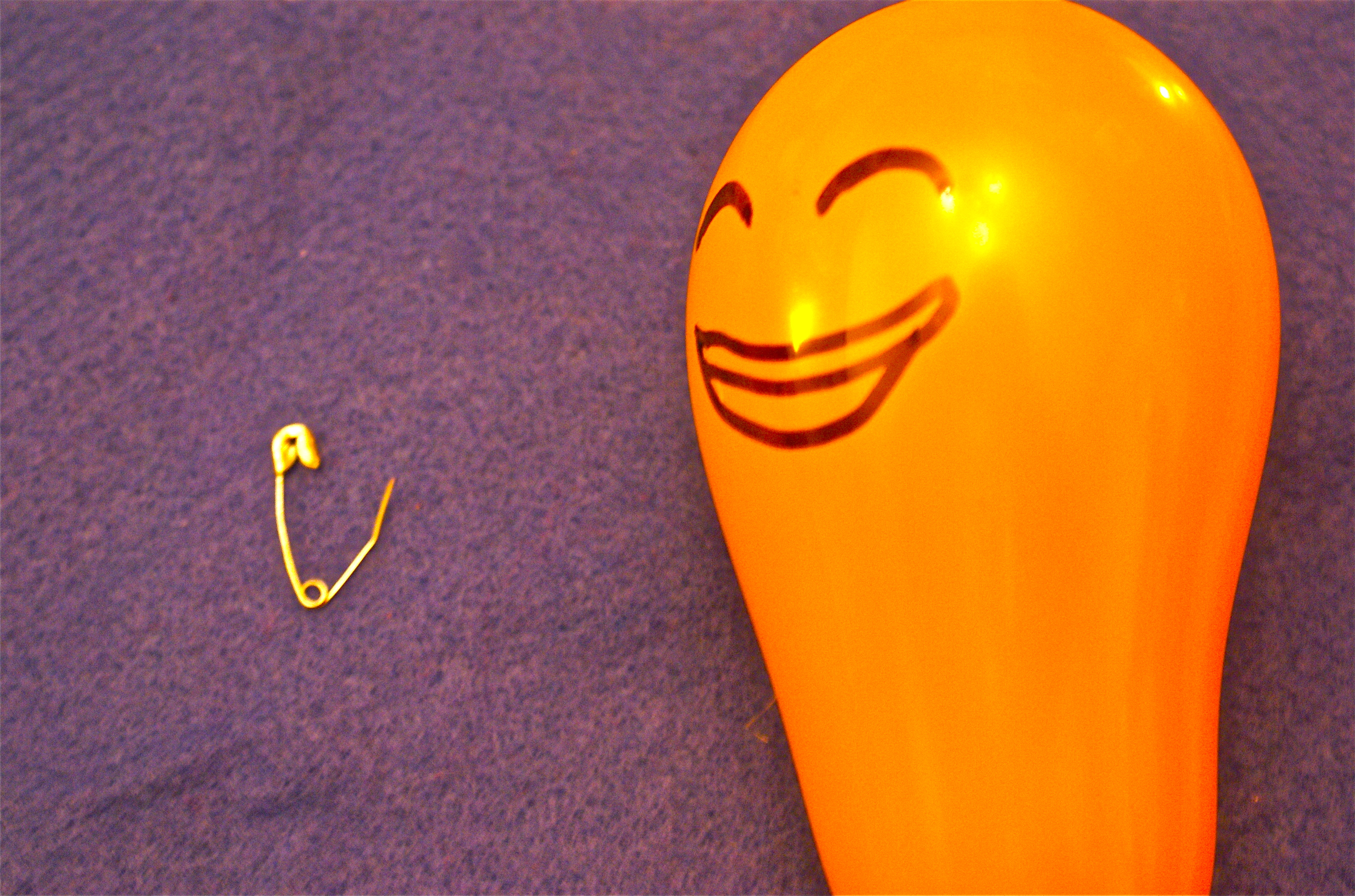
Mr. Walter Hunt would not approve. His once serviceable safety pin today is about as useless as a privacy setting on Facebook.

Wait just a minute! you say. What is the Tuesday Prude doing talking about sewing notions? Doesn’t the Prude only hold opinions on all things moral and ethical? And lapses in etiquette and grammar?

No. That is a fallacy. Prude disapproval goes far beyond the moral and civil code. We can find situations everywhere that need to be addressed and one of them is Shoddy Workmanship.

You may not be familiar with the aforementioned Mr.Walter Hunt, poverty-stricken inventor. He needed to make enough money to pay off a $15 debt. But what to invent? Inspiration was born of pain. Straight pins—the bane of the 19th century—poked holes in the epidermis of the general populace and Walter wanted to help. So he invented the safety pin.
Though history doesn’t tell us whether altruism or fear of a shake down by the local loan shark motivated Walter, he came up with a non-poking pin and made enough with his wire creation to pay his obligations.

Back then pins were made of materials with names like BRASS and STEEL. The safety pin Walter created from a piece of twisted wire was sturdy enough to convince some entrepreneur to purchase the patent.

For over a century safety pins continued to poke proudly. One could find safety pins holding up ripped hems, securing notes to kindergarteners’ backs, replacing popped buttons on trousers, removing splinters from fingers and functioning as fish hooks. Many women fondly remember when safety pins were sturdy enough to re-connect women’s foundation garments after a crucial strap snapped.

Back to Walter: if he’d tried to impress anyone with the 21st century piece of flimsiness pictured above (for which the Tuesday Prude paid good money),  his creditors would have broken his kneecaps and fitted him for cement shoes.

Te Tuesday Prude’s safety pin is not sturdy enough to pin a spider web to a snowflake. Instead of steel, it appears to be constructed of dental floss coated with spray paint.
If punk rock trendsetters had tried to shove one of these namby-pamby pins through their ears or noses or navels, an entire body piercing cottage industry would have folded before it had a chance to catch on.

Balloons don’t cower in fear from this pin. They dare each other to do belly flops on it’s stubby little point. The most wimpy of balloons laughs this pin to scorn.

Maybe somewhere a safety pin is doing its job and doing it well: keeping a starlet from a wardrobe malfunction, holding a baby’s diaper securely in place, or acting as a homemade compass in a 3rd grade science class.

But not this safety pin.

And maybe somewhere, Mr. Hunt looks down at this insipid descendent of his great invention and expresses gratitude that he didn’t name it the Walter pin.

The Lecture Lance

Readers of The Tuesday Prude may come here for real-life advice that addresses real-life issues. (‘What if my child’s eyes glaze over during lectures?’ or ‘Would this be a good time to lecture those in Washington DC who should KNOW BETTER?’) 
Any resemblance to actual expert advice by weapons tacticians, child psychologists or purveyors of world peace is purely accidental.
We want to educate you in the ways and means of prudishness and would love to build our ranks. But please take most of what we say with a grain of salt. Or possibly the entirety of Salt Lake City.

We wrap up our lengthy examination of Prude Weapons with the most potent of arms.
The Lecture Lance (LL)
Today we practice
 How to Use it.
We learned to brandish it only on those over whom you wield authority, or those who should KNOW BETTER. For our purposes we’ll call them Temporary Combatants (TC’s).
But don’t let its limited range deter you from becoming an expert in its use. A single human can and does make a difference. One person ( I’m going to invent something. I think I’ll call it Facebook) can influence one other person (and I’ll ask so-and-so to be my friend) and that person influences someone else (Hey! I can be friends with people I never met!) and soon the entire known universe is connected via status updates.
The same principle applies to The Lecture Lance. If everyone (E) uses one (1)  powerful lecture on each temporary combatant (TC) in their sphere of authority, all of civilization will soon feel the prickles of the it-has-to-hurt-to-make-a-difference Lecture Lance.

Are you skeptical of the LL’s power? We provide an algebraic proof:
If
E (1L x TC) = E (LTC)
And
the sum of E(LTC)  lectures everyTemporary Combatant in THEIR spheres (ETCS),
then:
ETC (1L x TC) = (ETCS) x infinity
which equals—well—you do the math.
We can’t. That’s why we are humor writers.

Remember. The Lecture Lance is your most powerful assault weapon. Drill daily prior to employing it in field combat.

Before a maneuver,  check that every part of the lecture is functioning.
Make sure to include:
Premise:  how fortunate the temporary combatant is to have a parent/authority figure who cares enough to lecture
Examples: how if ________ (ie. Attila the Hun / the neighbor’s drug dealing son / reprobate of your choice) had had an authority figure who cared enough to lecture, he wouldn’t have _______ (died from heavy drinking after battling Rome / currently be sitting in a Turkish prison waiting to find out which, if any, of his limbs the judge will allow him to retain / consequence of your choice)
Persistence:  several reiterations of “Don’t sigh and/or roll your eyes. It just makes the lecture longer”
Application: a recap of the TC’s lapse from good behavior and expectations for future improvement
Binding up the Wounds: fervent, though stern, affirmations of the long-suffering lecturer’s love and/or concern for the temporary combatant

Train diligently, and you can survive and even thrive in the heat of battle. Your can stand firm when the TC’s eyes roll backward and pause under the eyelids long enough to collect an opaque glaze. You won’t lose your focus in the face of sighs deep enough to suck all oxygen from the room.  And you won’t EVER let anyone tell you that you are nagging. Nagging is a battering ram poisoned with nerve gas. Instead of heightening the moral sense, nagging numbs it.

The Lecture Lance is a prude’s refined, humane, and effective means to prick the conscience of our temporary combatants and prod them back onto the path of good behavior. Our dream is that some day, history will point to prudes and say: Never in the field of human conflict was so much owed by so many to so few.*

*Winston Churchill, a man who knew the power of words.

The Tuesday Prude is WHERE?

If you are in the mood for the politically correct versions of titles, or what happens when authors forgo a thesaurus when titling a book, head over to The Barn Door. The Tuesday Prude is hanging out there today with a little something we like to call ‘Little Women? or Small Ladies?

http://www.thebarndoor.net/2013/09/little-women-or-small-ladies.html#comment-form