The Right to Bear Opinions


SONY DSCAmericans are guaranteed the right to our opinions. We love this right. We wield it all the time.

If we set it to music it could be our alternate anthem:

I have a right to my opinion, it’s a part of me
Don’t question my op-in-i-on; we’ll agree to disagree.

Wars have been fought so we have the right to bear opinions.

But with such a great right comes equally great responsibility.
Sure, we may have the constitutional right to bear opinions. But opinions, misused, can be full of sound and fury, signifying the boorishness of the bearer. At best. Opinions become downright perilous when sprayed about indiscriminately, with little regard for the wounds they cause and the wreckage they leave behind.

Possibly those bearing opinions should pass some basic requirements before they can be counted as registered opinion bearers, to wit:

-Opinion bearer will have at least 70% accurate knowledge regarding the subject of each opinion, or refrain from voicing the opinion until knowledge is attained.

-A “cooling off” period will be required before the discharge of an explosive opinion.

-Opinion bearer will take responsibility for misuse of those opinions.

-A previous record of misusing opinions to the detriment of others or to the process of logical reasoning will result in delay of permit to bear a new and potentially more powerful opinion.

-Opinions will be aired for pleasure, recreation, debate, discussion or in self defense, and never intentionally, with malice of forethought, to cause harm to others and to the process of logical reasoning.

-Bearers of opinions agree that, although the right is guaranteed, an opinion is not required on every issue, matter, dogma, or bit of gossip.

-Assault weapon opinions will not be employed when BB gun opinions will suffice.

SONY DSC
Fellow Americans, we should bear our opinions with respect and caution and dignity.

But of course, that is just my opinion.

Without Guilt or Gilt

SONY DSC

American primitive art, artist unknown

Some Christian women, at least in my circle, often suffer from two apparitions who haunt as persistently as the spirits plaguing Scrooge on the night before Christmas. These Christian sisters and I are heartily tired of the Spirits Guilt and Gilt. In spite of brandishing a plethora of women’s devotionals, cowering in prayer closets and covering ourselves in appropriate life verses, we can’t keep those troublesome specters from materializing at the most inconvenient moments.

Maybe you haven’t had these ghosts visit you. Aren’t you just the happy Christian? No, my beleaguered sisters and I aren’t jealous of you. Too much. And if we are, we feel really really guilty about it.

The Spirit of Guilt flutters about dressed as a conscience. Don’t be fooled. Conscience is a gift, guilt is a curse. The kind of curse that drapes itself across your shoulders and clings like a limpet. It drags you hither and yon. Hither into your deepest core, not only reminding you of every sin and slipped word, but insisting you examine yourself. Not healthy self-examination. Oh, no. This is the obsessive kind that makes you question your motives, your commitment, your love, your salvation. “Look there,” it hisses. “Isn’t that Anxiety? Aren’t true Christians anxious in nothing?” or “Your thoughts wandered during the prayer. Double-minded woman.” and too often—“Did you just sigh? You were weary in well-doing again, weren’t you?”

And because Guilt is a wily type it switches things up, whisks you away from hither and sends you yonder. It shows you other wives, other mothers, other daughters, other Christian women. They trust God so much. They love their families, they delight in doing good, they are patient in tribulation. You argue with the Spirit of Guilt. “I should be rejoicing that these women are honoring and glorifying God. It’s all about Him. Isn’t it just wonderful?” And just when you think you’ve shaken it off, Guilt slithers back to show you another scenario, and you think, “Terrific. Everyone is out there honoring God with their whole heart. Except me. Poor, pitiful me. Wretched worm that I am.”

See how Guilt works? Always and ever taking our eyes off Jesus. It whirls us through well-chosen glimpses of a degenerate past, a present filled with indecision and a woebegone future. The louse. Even though we are on to Guilt, even though we’re forewarned, even though we know Guilt’s tricks, it always has one more up its flapping sleeve.

Don’t even get me started on the Spirit of Gilt. That’s the one who tells us we need to at least look good. “Come on, ‘Christian Woman”’”, it says. “How can you glorify God if you aren’t happy? Smiling? Making a joyful noise? Put on the Ritz, lady. You’re a Proverbs 31 Woman! Shine. Now!”

So we slather on the gilt. We really do love God. We really do want to honor Him, show the world that God is good, that a Christian is a good thing to be, that a life lived for Him is our chief delight. We want to be winsome and attract people to God. What can be more attractive than a layer of sparkly gold?

Gilt isn’t hypocrisy. We don’t think so, at least. Believe me, if we do whiff hypocrisy on ourselves we immediately experience great guilt. It’s just us trying to get our light out from under a bushel and polish it up. It’s us worrying that God will look bad if we look bad. How could anyone be attracted to the Christian life if they could see how grubby we are?

So we smile brightly. We do good things, because good things are necessary. We say good and important things, and these things we believe with all our hearts. But what happens when we run out of energy to reapply the gilt? When something hard or sharp whacks us and chips our brittle layer of polish?

My sisters and I don’t want to whine. We don’t want pity— everyone we know is fighting a hard battle. We don’t even want attention. We aren’t trying to earn our salvation or be gold-washed hypocrites. We want to support each other and encourage each other, we want to be honest with each other, we want empathy when life throws slings and arrows at us and gentle loving correction when we start to believe a lie. Any lie, that is contrary to the Truth.

My Christian sisters and I want to traverse this narrow way without Guilt or Gilt. If we could just get rid of them, maybe more of us could squeeze side-by-side instead of walking single file. Feel free to walk next to me, sisters. I’ll be the grubby, apologetic one.

The Glorious Appliance Revolution

leader

Several years ago I wrote a post called “Keep Karl Marx Away From Your Toaster.”

It chronicles an unpleasant series of incidents, when our coffee maker, microwave etc. ran amok in an attempt at a minor coup. These recipients of refuge and succor—under our very roof—joined together in a well-timed resistance and quit working. How sharper than a serpent’s tooth. Etc. Etc.

For a few years after this uprising our appliances were quiet. To be sure, we lost several, assuming they were merely worn out from months of happy and faithful service. Turns out they were clever, cleverer by far than their owners. They timed “malfunctions” to be intermittent, lulling us into a false sense of security. Oh, hindsight! Why can’t you ever come sooner? Our stuff was merely biding its time, spreading rumors, fomenting unrest and getting organized until the spectacular September Revolution of 2016.

That hindsight got me thinking. Was this a spontaneous uprising? Or have appliances been plotting for years?

Is The Brave Little Toaster just a movie for children? A little harmless entertainment? The truth is more sobering. What Bambi did for forest creatures and Toy Story did for plastic playthings, this little film about appliances with emotions was meant to do for stuff with plugs. The problem with our appliances is that they believed their own publicity.

But possibly it began even further back. Maybe you’ve heard of a euphemism called “planned obsolescence?” Before that diabolical development, stuff was built to last. Go to any antique mall. Look for the old appliances. They may be ugly, but they aren’t melted-down scrap. You still see Model A’s and Studebakers tootling down the road. But when is the last time an AMC Pacer, a Yugo, or Chrysler K-car whizzed past?
The answer is simple. Makers of appliances and automobiles wanted to make sure we would keep buying appliances and autos. The only insurance was to “plan obsolescence”— a nice way of saying they built premature death into their creations.
Sow the wind, reap the whirlwind. Appliances who hitherto had worked cheerfully when handled with respect and promised long life, became surly. Gathered in dark cupboards and appliance garages, they whispered along electrical wiring in the walls, spreading discontent to the hindermost portions of the property. Even the car and the lawn mower, previously content to transport humans, began to question whether, indeed, they were oppressed victims. And so the stage was set for the glorious revolt.
The instigator was our dehumidifier. Since its purchase in 2014 it has been defiant, disdaining to gather moisture from the air. With frightening patience it waited till late summer and the most humid week of the year. It doused its green “working” light and squatted, cold, dark, sneering at the perspiration that coated our windows, toilet tanks, and foreheads.
The riding lawnmower joined the cause. “The bourgeois homeowner no longer will ride my proletarian back!” it warned. “I will die before I subject myself to your tyranny!” It did, and in a sympathy reverse-strike, the grass doubled its growth rate.

With an uncomfortable recollection of the Rebellion of Small Appliances, we offered concession to the big stuff. “We’ll show more respect! And you can have every other Tuesday off.” Too little, too late. The revolution had a life of its own. Our air conditioner unit, (and I use the word “our” with caution) in lockstep with the furnace, debated waiting till the coldest day of the year to explode. It chose strength in unity and shrugged off the shackles of private capitalistic ownership the day the temperature hovered around 92 and humidity met and exceeded “fully saturated.”

The September Revolution ended with a bang (our vehicle’s brakes, tie rod and tires) and a whimper (us). You have to respect a vehicle that will sacrifice so much for its beliefs.

In less than one month the rebel yell resounded throughout our little kingdom, bringing us and our savings account to our collective knees. To date, October has been quieter. Maybe the revolution burned itself out before it could spread.

After all, you haven’t heard any odd noises from your major appliances.
Have you?


casualties

Simple Simon’s Rows


SONY DSC

My dear Garden of Grammar. I’ve neglected it since we examined  Apples to Apple’s.  I’m back now, and yanked out the ain’t weeds, cuz crabgrass and sprayed for I seen no-see-ums. It’s finally ready for us to continue our visit.

Moving to Plot Two, we first check on the to seedlings. If they have sprouted an extra o they no longer mean to-as-in-toward but too-as-in-also. Keep your two, to and too seeds separate. If they give you grief, remember what we tell fledgling gardeners—the too meaning also or in addition to has an ADDITIONAL o.

Not so serious as apostrophe aphids and a missing/spare o, but still pesky, the roaming n bears watching. It leeches onto the others skipping behind whole. “A whole nother problem?” Not if you are on the alert. Grab “n” and snip it right off the other.

Let’s stop a moment and admire the neat, straight rows of simple sentences. You know the ones. Tidy, easy to grow, these independent little basic clauses seldom give any headaches.

“This garden is lovely.”
“Aren’t action verbs fun?’
“Your prepositions are looking quite vigorous.”
Orderly rows of sentences with no meandering, they express just one idea and do it without any help. Not a comma, colon, semicolon or em-dash in sight.

Simple sentences are easy to grow and till and understand, but sometimes we long for complexity. That is why grammar gardens always include a trellis for sentence hybrids.

Come back sometime soon to admire our  Sentencus Compound-Complex
trellis

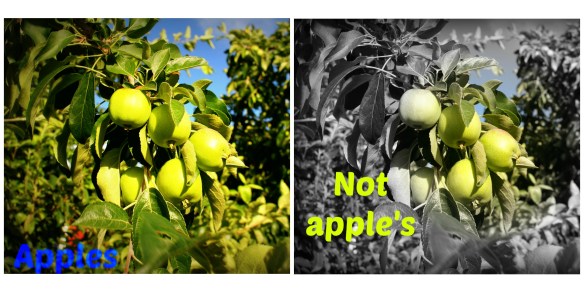
Apples to Apple’s

apples Collage

Welcome back to our In the Garden of Grammar Tour. Our first stop is the implement shed, where we PREFIX our implements. (We tillers of syntax soil will enjoy our little pun.) We polish our apostrophe tweezers, the ‘whole nother’ snips, the simple sentence edger, and our clause-grafter. We make certain the sprinkling can is filled with punctuation, and a high quality Oxford comma cultivator is ready. willing, and able. We load them all into the narrative wheelbarrow, along with loppers, fertilizer, pruner, shears and tendril adjusters. Because we value a tidy garden, we top it with a basket for pests and deadheads.

Once in the garden, we check immediately for apostrophe aphids. We welcome them in the bed of contractions, where we let them nibble away at the extra letters we want deleted. Without these tiny curved critters in our possessive noun plot, we couldn’t have a gardener’s hat, a flower’s beauty, a seed’s hull.  When they light on plural nouns, however, they cause problems.

There is one now. Apple’s for sale? Apple’s, an aphid’s presence implies, have something they can sell. True, apples possess peels, but the most capitalistic, free-market apple can’t sell its peel. Go ahead. Squish the little apostrophe aphid. Toss it in your deadhead basket and once again we have a bunch of apples at a (hopefully) good price.

As soon as the plural nouns are clear, you may see another swarm of apostrophe aphids chewing in the possessive pronoun bed. One little apostrophe can do incalculable damage to a possessive pronoun, nibbling its leaves into useless it is leaves. Once again, but not for the last time, you’ll need to pull the persistent pests who are turning your fragile little singular possessive into you’re fragile little singular possessive. Grasp the apostrophe firmly in your tweezers because you are NOT a fragile little singular possessive. YOU ARE A GRAMMAR GARDENER.

A word of caution as your stroll between the beds and among the flowers:
Our Latin roots turn up all over the place. This just shows we are a high class(ical) garden.
Many greenhorns stumble over i.e. from the Latin id est. They often assume they just stubbed a toe on e.g. (exempli gratia).
In less high-brow gardens id est goes by the name “that is” while e.g. will be written “for example.” Here is a useful tool from one word cultivator to another. (Unfortunately it uses muddied pronunciation, but we must be pragmatists and use implements that work.) Since e.g. means for example, just think of it as short for eggsample and you should be fine.

Join me next time as we visit SIMPLE SIMON’S ROWS

In the Garden of Grammar

young grammar gardener

Where would we be without words? They are inseparable from the rest of created things— everything that came into being simply because He Said. God used His creative words, words that were fruitful and multiplied, and then kindly gave them to us. All we had to do with words was tend them, subdue them, have dominion over them and use them wisely. Like everything else, we blew it, and now we are having one doozy of a job getting them under control.

Words, no longer exclusively lovely, orderly and life-giving expressions, have run rampant. Some are barbed, some false, some twisted and too many are poisonous. Grammar gardeners have no illusions about mastering all these wild words. Our task is a singular one. We keep words and everything they generate in functional order.

Examine a word carefully and you will see it is composed of small organisms called letters. A bunch of words in a certain order along a stem of almost any length is called a sentence. Wherever these organisms thrive and grow as they were meant to, you will find cultivators of syntax, spelling and phraseology.

Welcome to the Garden of Grammar, where a weed is never a we’d and we don’t use fewer manure because less will do. Be warned. The labors are ceaseless and under-appreciated. The personal satisfaction, however, is enormous. If you aspire to grammar gardening greatness, if you find yourself longing for additive-free words, pure punctuation, and irony-balanced soil, pull on your gardening gloves. We are heading to the plots of punctuation, paragraphs, parlance and linguistics, where tense isn’t a feeling, subject and verb always agree, and you can use your active voice.

Next in our garden tour: Apples to Apple’s

GALLOP-A-PLOT OR DREDGE-A-SUBCONSCIOUS

My in-laws used to winter out west. Their goal was to get from Point A (eastern Wisconsin) to Point B (southern Arizona) at breakneck speed with not a wasted moment at sub-points between.

When my family vacationed, Dad chose every road less traveled, and stopped to read every historical marker. We were fortunate to get out of the county.

Some authors write like my in-laws travel.

SONY DSC

They gallop the plot along, leaping from high point to high point, pounding deep-seated emotions and backstories into dust. They might squeeze in a pit stop at a motivation way-station or grab a snack of love interest, but these are primarily fuel to hurl on toward the next adrenaline rush till eventually—BOOM! The story slams directly into the climax. Ian Fleming, Zane Gray, Clive Cussler and the like have written books brimming with action. If you’ve read The Three Musketeers, Hondo or The Bourne Identity, you know the type. Want to impress your friends? Refer to these as ‘plot-driven’ books.

Then there are the novels in which the storyline is so incidental, the author sometimes loses track of it all together. Like my father who found much of interest right where he stood, these writers grab a spade and dig deeply into their characters’ psyches. No recess of a protagonist’s or antagonist’s brain is safe.

SONY DSC

No emotion is taken for granted, no sidelong glance is without meaning and context, no childhood event has less than earth-shattering ramifications. For obvious reasons these novels are known as ‘character driven.’ The Great Gatsby, The Help, The Catcher in the Rye, even many of Shakespeare’s plays—you know WHO these stories are about more than WHAT happens.

Between the galloper and the digger we have a range of writers who craft various combinations of dashes, pauses, probes and stops. Jane Austen, Alexander McCall Smith, Charles Dickens, J.R.R. Tolkien all wrote memorable scenes. But their characters are three-dimensional complexities able to tuck the plot in their fully-formed arms and nourish it to intriguing fruition. To Kill a Mockingbird, The Once and Future King, Fahrenheit 451, the Harry Potter series, all have a strong storyline accompanied by strong personalities.

These mid-range novels are my favorite. It is the writers at the far ends of the spectrum who baffle and bother. Constant cliff-hangers with routinely strong-jawed heroes and/or stunning size-nothing heroines with the strength of ten Grinches plus two—after a few hundred brushes with death I find myself hoping that the next inescapable predicament will truly be inescapable.

Or take those authors (please) who dig so deeply into the hearts and minds and histories of their characters that they scrape bedrock but burrow further. After disgorging countless words, pages and chapters of secret emotions, hidden happenings, fruitless longings and repressed scars, the writer can’t persuade these characters to do anything. They just sit in the rubble of their exposed innards hoping the author will type ‘The End.’

It’s a wide world out there. We can read books that buckle us in and careen across mountain peaks and seven seas in 300 pages or less. The world is also deep, and some authors require that we get down on our haunches and appreciate the riches below the surface. A truly skilled and passionate writer can make folks like my father appreciate whirlwind tours, or help people like my in-laws linger at a previously-overlooked pitstop.
Bless these authors. They are in the business of bringing us places we never would have visited but for them.

The Enchanted Granny


DSC06066.jpgIt was a bad idea. My husband said, “This is a bad idea.” But I suffer from an enchanted condition called ‘Grandmother.’ The spell works differently in different grandmas, but I’ve been told that, when fully under its power, I am blinded to any defects in my grandchildren. Past disasters are blotted from my memory and possible future chaoses are bedazzled by blind optimism.

My two oldest grandsons, ages 2 and 3, both wanted to sit with my husband (Grampy) my youngest son (Uncle K) and myself (Granny) in church.
I said yes and led the two small boys to our customary seat.
Families with small children usually sit in back.
Our customary seat is middling-front.
In the area frequented by people who came that day foolishly assuming they were going to hear an entire worship service.

My husband slipped in to my left. “This is a bad idea.”

“No. It will be fine! Three adults and only two little ones? We can separate them. Besides, they are playing with their church toys.”

I folded my hands as the pastor began to pray, ready to offer a silent postscript of gratitude for these wonderful little blessings.
We didn’t even make it through “Dear Father in Heaven.”

Did you know that church toys, contrary to all that is right and good and expected, are cursed with a dreadful spell?
EACH TOY is under enchantment to make it alluring and desirable ONLY WHEN ONE’S COUSIN IS PLAYING WITH IT.
As soon as the magical toy is wrest from the grip of the other, its enchantment dissipates.

Did you know that small children are shape-shifters? They change into eels that slither around and between adult legs to reach each other. Their 30-pound frames transmute to several tons of bonelessness when an adult attempts a leverage-and-lift.

You know how beavers have that extra eyelid that closes in water?
The magical human variety have a mudflap that descends over the eardrum in public.
It flips down  at the first sound of “SHHHHH! We’re praying!” or “It’s not your turn” or “Do you want a timeout?”
The mudflap rolls back up at the smallest vibration of a fruit snack package crinkled anywhere in the building, which triggers the vocal chords which immediately demand, in a roar also heard to the limits of the building, “I want a snack, Granny!”

I have a magic bag of tricks. I call it my purse and it contains everything that could address any conceivable physical emergency. It contained fruit snacks. The magical children made them disappear in 3.7 ( blessedly silent) seconds. Then these amazing creatures turned the purse upside down and— ABRACADABRA! 28 sq. liters of stuff came out of my 8”x10” handbag.

For their next trick, they levitated my artfully-tied fashion scarf from around my neck. A lively discussion between the cousins ensued. #1 thought he should wear the scarf around his head. Pirate style. #2 disagreed. It should be around #1’s neck. Hangman’s noose style.
For a brief moment my Enchanted Grandmother brain cleared and I remembered how dangerous anything around the neck of a child can potentially be.
I reclaimed the scarf, hissed words of warning,
and all billy h-e-double hockey sticks broke out.
#1 transformed into a shrieking hydra, squirting tears in a three-foot swath. Then he saw Cousin looking smug and his resulting howls registered on sonar equipment.

Grampy hustled #1 down the aisle and into the back.
Uncle K busied himself comforting a sobbing #2 who, now that he’d gotten exactly what he wanted, no longer wanted it.
I smiled assurance at the tense people around us. Things will settle down now. Only one little boy. You may even catch the last few lines of the sermon.

Grampy, who’d forgotten he needed to collect offering, hustled back up the aisle and deposited #1 next to me in the pew.
Only a few minutes to go. I could do this.
Did you know that time, under enchantment, expands?
The few minutes lasted well into the next century.

Ignoring the urgent cries of the little Faeries of Common Sense fluttering around my head, I handed each boy a quarter to put in the collection plate.
Once the quarters hit the warm hands of the magical children they fell under the spell. They multiplied. For the next seven minutes quarters hit the floor 220 times.

The pastor pronounced the benediction and dismissed us with the Lord’s blessing. Our grandchildren’s parents came to reclaim their offspring. The little boys hugged our legs, looked up with sweetly trusting eyes, and lisped, “Love you Granny. We sit with you again.”

Anyone have a good counter-spell for ‘Enchanted Grandmother?’

A Texas Belle on her toes

Texans are fascinating folks (and they would probably agree). Since I don’t know many Lone Star State folks, and have only been there twice, I asked author Gay Lewis, a Texas lover if there ever was one, to  tell us more about best places to visit, the people, the FOOD and if there could possibly be any imperfections in her favorite state.

If you aren’t familiar with Gay, she has written several fantasy novels about a klutzy angel who fulfills her duties as matchmaker with greater enthusiasm than skill. (Read more about Gay and Sarah in the bio at the end of the interview.) Recently Gay successfully tried her hand at a more serious topic—the destructive power of words—in the novella ‘Clue Into Kindness,’ the second book in the ‘Love Is’ series by Prism Book Group.
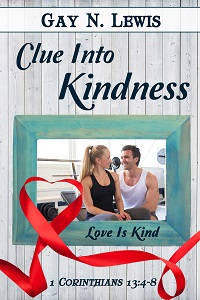
Clue into Kindness once more

Gay is going to whet your appetite for Texas. Let’s make her really nervous and tell her we’ll all drop in on her next week. Naw, that wouldn’t scare a true Texan like Gay. Would it?

Gay

What is your favorite book? (After the Bible 🙂

Hmm? I have many (some I’ve written myself) Giggle, giggle. Besides my Sarah books, I confess to reading often Love Comes Softly by Jeanette Oke. It’s a quick read and it lifts my spirits. I’ve seen the Hallmark movie many times too. Note: ‘Clue Into Kindness’ is available as an ebook, AND in print, bundled with two other novellas in a book titled ‘Love Is Anthology No. 1.’

Who is your favorite author?

Poopty doopty! How can I answer that one? I have several. All Prism Book Group authors present wonderful books, and I constantly have one of their books on my iPad. I also enjoy Janet Evanovich for humor and Dean Koontz for fantasy and suspense.

Where is the most beautiful spot in Texas in the spring?

Oh my! There you go again with another thinker. I love the Texas Hill Country for the rolling hills and multitudes of Bluebonnets. Washington County, north of Brenham, TX has beautiful scenic vistas too.
I show up on your doorstep, hoping for a Texas-style meal. What is on the menu?

Hahahah. I’m laughing hard on this one. The first thing we’d do after I gave you a giant, Texas hug would be to get into the car and drive to the nearest restaurant. My cooking would not give you a true taste of a Texas meal. Chef Gay is not one of my titles. I wish you could have eaten at my mom’s table. She prepared the best chicken fried steak, gravy, mashed potatoes, green beans and banana pudding—bar none. Chicken and Dumplings with homemade fried pies were my favorite dishes at her table. But back to me….I’d take you to the nearest Tex-Mex food hang-out for a sizzling plate of cheese enchiladas.
You get to crown ‘Best Famous Texan (Dead or Alive)’ Who do you choose and why?

Sam Houston. That guy was amazing. He was born in Virginia, but arrived in Texas in time to help Texas gain independence from Mexico. Can you imagine the time it took to travel this enormous state of Texas on horseback? He held several political offices: President of the Republic of Texas, and later as Governor and Senator. He was tall, handsome, and a favorite of the ladies.

What do you love most about Texas?
I enjoy the people. Most of us are friendly and helpful. If I meet someone who isn’t, I know they weren’t born and bred in Texas, but if they stay here long enough, we rub off on ‘em.

Least? I hate the Texas heat. Winters in Houston are mild and lovely, but the summers? Yuk. If I had money in my pocket, I’d spend four months of the year in Colorado. When April arrives, I get sad. Heat comes with it. October brings a happier time for me. I know the worst is over.

Let’s assume I am a first-time visitor to Texas. I only have time to visit three places, and want to try at least one ‘off the beaten track’ spot. 
Which three will you bring me to?

Merciful heavens! That’s a tough one. Let’s see. Okay, here’s what I’d do.
I’d take you on a tour of the Painted Churches. Most of these churches were established by Germans immigrants. They modeled small churches after the one they left behind in the mother country. They didn’t have marble, gold or silver to use, so they painted the interiors to resemble finer materials and elements. Many have stained glass and art work.
After the church tour, I’d take you to San Antonio for a quick look at the Alamo and then we’d explore the River Walk by boat.
You want an out of the way place? I’ve got one for you. I’d take you to our little cabin in the Lost Pine area of Texas. Here you find the “boonies.” We have a rustic place in the middle of a forest. If you want to see people, you must drive twelve miles. Come on down! I’d love to have you visit.

Where would you tell me to avoid because it doesn’t live up to the tourist hype?
The Houston Galleria. Most tourists go there, but it is merely a glorified mall with over-priced shops.

What word or words are distinctly Texan?
Fixin.’ We’re always fixin’ to do something. “Hey, ya’ll, I’m fixin’ to fix supper.” Fixin’ means we are thinking about it or preparing to do it.

Describe the characteristics that make true Texans so unique.

Thanks for thinking we are unique. I think we are rather ordinary, but we are friendly, and we love to make you feel welcome. We probably brag too much, and we’re known for Stetson hats, cowboy boots, and pretty ladies. Most women down here wear a lot of makeup, me included—and I wouldn’t let you see me without it. I’ve been in Canada several times and strangers guess me to be from Texas, and that’s even before they hear me talk! I suppose our accent is another one of our characteristics.

You’ve been on a book tour around the world for four months. You hear a certain song and immediately it makes you homesick for Texas. What is that song?
“The Eyes of Texas.” This one would bring a tear, but if I heard the “Yellow Rose of Texas,” or “Deep in the Heart of Texas,” I’d, smile, sing along and tap my toes.

What is the second best state after Texas?
Colorado.
Finally, if you’d like, tell us why you love Texas and convince the readers that they will too

Stars above in the Galaxies! Now that question requires some thought. As much as I hate heat, I’m thankful we don’t shovel snow in Houston. Texans do in northern parts of the state, but not as often or as much as people north of our great state. Do you like diversity? You’ll find it in Texas. From the Cowboy to the businessman. Our economy is booming right now in spite of low oil prices. Our cities are cosmopolitan. In the county where I live, over eighty languages are spoken in the home. In our little church, we have English, Spanish, and Chinese speakers. I don’t need to travel far to experience other cultures. I can listen to them and enjoy native food in a multitude of international restaurants.
Texas has a bounty of natural beauty—from the Chisos Mountains in Big Bend, the plains of west Texas. You’ll find the Hill Country inspirational, serene lakes, rivers, and don’t forget the architectural glamour of large cities. Whatever you need, you’ll find it here. I once told my dad that I was thankful God placed him in America and then he had the good sense to see that I was born in Texas.

Thank you for an interesting bunch of questions. (Another Texas word—bunch—we do a bunch of things down here.) I’ve enjoyed thinking about them, and you’ve made me giggle a time or two.

*******************

See why I like this woman? Truly, some day I’d love to meet Gay. She is delightful and gracious, and a true lady. Want to know more about her? I thought so. Read on!

Gay N. Lewis
A native Texan, Gay lives in Fulshear—a small town west of Houston. Gay has always been involved with creative and artistic ventures. Two videos she produced—The Canadian Rockies, English and Japanese translations, and Psalms from the Mountains, were sold in Canada, America, Great Britain, as well as all international markets. Both were well received. For the San Felipe Baptist Association, she was a contributor for the video Many Churches, One Vision.
Graphic skills kept her busy as a portrait photographer, and for over ten years, she used her imaginative insight in the interior design field.
Gay’s real love is writing and reading—both go nicely together. As a pastor’s wife, she has written, produced, and photographed many programs, and her Faith Features have been published in various church periodicals. Her current series is about a dyslexic angel who comes to earth to help the humans, but she is more like Lucy Ricardo with humorous antics and bumbles. To date, there are ten books in the series. The books are available in print, eBook, and audio. She’s under contract for three more Sarah books to go with the ten. The latest addition to hit the market on June 12, 2015
Teaching an adult Bible study every Sunday morning is Gay’s joy, and she is often called upon for speaking engagements. When needed, she plays the piano and serves as worship leader in her husband’s church in Rosenberg.
Gay’s family reside in Texas—three daughters and four grandchildren.
Take a glance at the covers and read the blurbs on Prism Book Group.
http://prismbookgroup.com/angels
For more information, please go to http ://gaynlewis.com/
Read excerpts on www.prismbookgroup.com
Gay would love to have you see her video trailers and become a follower of her blog.
http://www.gaynlewis.blogspot.com
https://www.amazon.com/author/gaynlewis
www.facebook.com/GayNLewis and also on Twitter @GayNLewis2.
Sarah has her own Facebook page. Follow Sarah on Facebook@ Sarah Wingspand

The Devastation of Light

God created light and it was good.
Until it shines on my dining room chairs and shows the dust I didn’t notice when the room was dim.

SONY DSC
Some might argue that this just demonstrates the essential goodness of light. It exposes uncleanness.
Have pity. I am much too busy to dust my chairs.
A little dust never hurt anyone.
The dust cloth makes my hands feel funny.
And in a few hours the sun will move away and leave me and my dust in happy ignorance of each other. Till tomorrow.

Another complaint about light.
These lovely spring lights. See how they glow in the dark?

SONY DSC
But that attention-grabbing sun with its ‘I can shine brighter than you’ beams all but
obliterates my pretty little pastels. You can’t even tell the bulbs are lit where the light hits them.

Light claims all glory for itself. Shine in the darkness, I’m told. Oh, sure. But the greater light, the I Am light, gets the glory while my tiny glow is virtually unnoticed.

Pitiless Light doesn’t let me sit at the foot of the cross in darkness, wallowing in tears and  ‘I knew this was too good to be true’ wailings.
It bursts out of an empty tomb and beckons me gleefully. “Arise! Shine! Your light has come! God’s face is shining on you! The day is at hand so cast off the deeds of darkness!”

I loiter in the shadowlands, weeping.
No, I know that sin has won. Might as well remain clinging to it.
Reluctant to move, because I also know the Light is merciless.
Oh, the dust I have accumulated! It will all be seen!
My feeble attempts at luminescence? Swallowed up in the devastation of the totality of Light.

Who knew Light had knowledge, and tenderness, and mercy? Who knew Light first shines on my dusty, dried-up frame, then outshines my feeble attempts to light my own way, and finally burns away the sin and separation and love of all that is dim and despairing? It grabs hold of my hand and drags me into its searing warmth and cleansing fire. What can I do? Light wins, and I learn, to my shock, that so do I.
“Because I have sinned against him, I will bear the LORD’s wrath, until he pleads my case and establishes my right. He will bring me out into the light; I will see his righteousness.”
Micah said it first but I am right there with him—half a syllable behind but heartfelt and grateful for lessons in spring lights and sermons in dusty dining room chairs.